

Dato’ Dr Ooi Kee Beng of Penang Institute on ASEAN’s moment of choice, the Bandung legacy and Southeast Asia’s role in a multipolar world
- Bandung 1955 and the continuing relevance of strategic autonomy
- ASEAN’s opportunity to become a stronger pole in the emerging order
- China’s rise, regional cooperation and the possibility of a less hierarchical world
By Lin Siu-loong
THERE is something almost cyclical about the present moment. Seventy-one years after Asian and African leaders gathered in Bandung to imagine a different international order, many of the questions that confronted them are returning in new forms. Who determines the rules of the international system? Can smaller and middle-sized countries maintain their independence when great powers compete for influence? Can economic cooperation coexist with political differences? And, perhaps most importantly, does a country or region have to choose sides when the world is divided between competing centres of power?
In Part 2 of his interview with Dr Pascal Lottaz, of Neutrality Studies, Kyoto University, Dato’ Dr Ooi Kee Beng believes these are not merely historical questions. They are increasingly contemporary ones.
“The 1955 Bandung Conference brought together 29 Asian and African governments at a moment when the Cold War was hardening into a confrontation between two major blocs,” he says. “The conference focused on peace, decolonisation, economic cooperation and the right of nations to determine their own futures. Its principles included respect for sovereignty, non-aggression, non-interference, equality and peaceful coexistence.”
Bandung did not create a world without power politics. But it created an idea: countries outside the great-power blocs could exercise agency. That idea remains highly relevant to ASEAN today.
Bandung flashback
The historical parallels are striking. In 1955, many Asian and African nations were newly independent. They were determined not to exchange colonial dependence for another form of subordination.
Today, ASEAN’s members are sovereign states, but they again find themselves in a region where major powers compete intensely for strategic, economic, and technological influence. The difference is that the contest is no longer simply between two ideological blocs. The emerging international order is considerably more complicated.
The Bandung leaders responded to a divided world by insisting on principles that placed sovereignty, equality and peaceful coexistence at the centre of international relations.
China is a global economic power. The United States remains a major military, technological and financial power. India is becoming increasingly influential. Japan and the European Union remain important actors, while the Global South is demanding greater representation and influence. For ASEAN, this creates both risks and opportunities.
The Bandung leaders responded to a divided world by insisting on principles that placed sovereignty, equality and peaceful coexistence at the centre of international relations. Those principles have not become obsolete. Indeed, they may become even more important in a multipolar era.
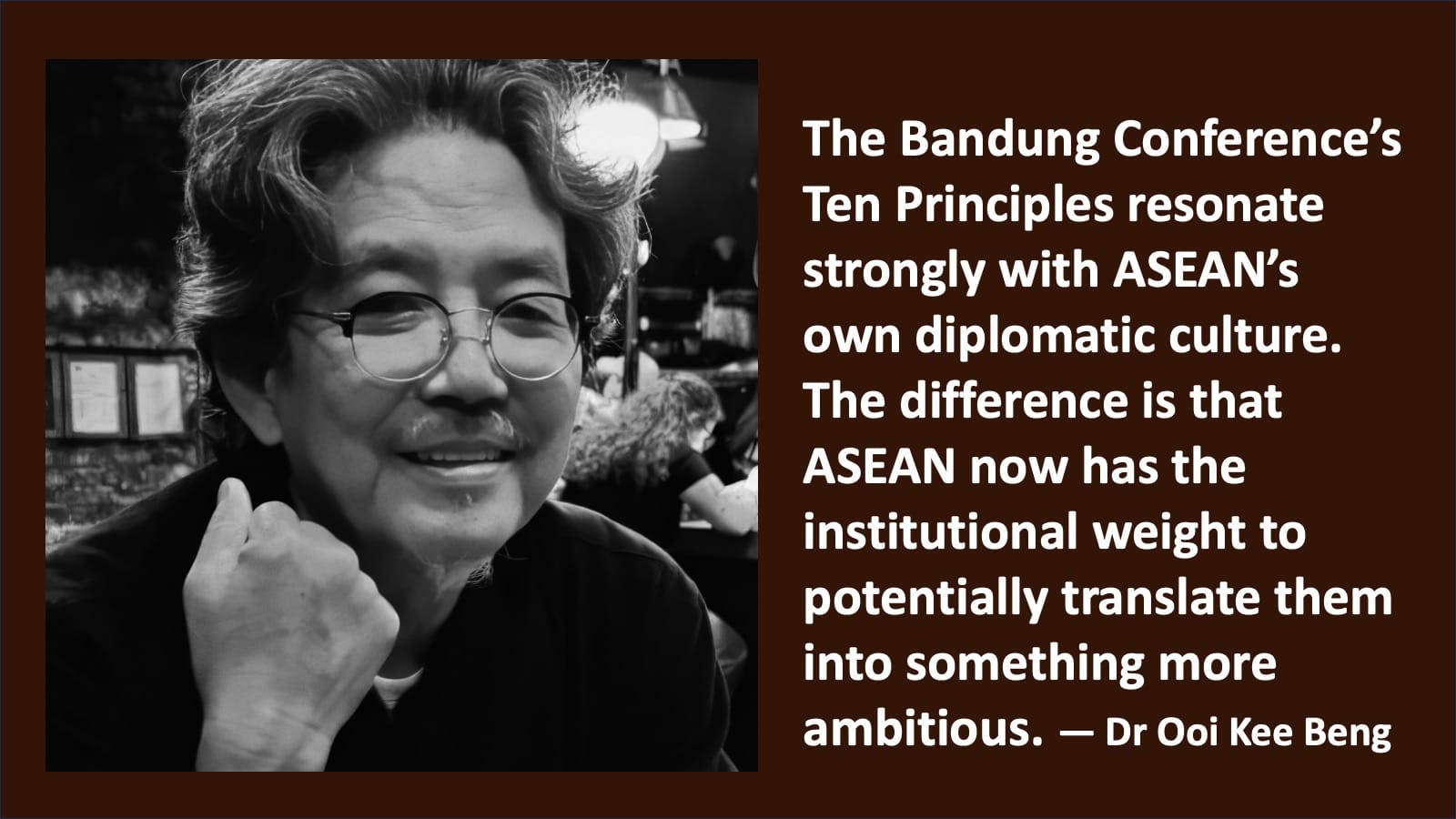
The Bandung Conference’s Ten Principles emphasised sovereignty, equality among nations, non-interference, peaceful settlement of disputes and cooperation for mutual benefit. These ideas resonate strongly with ASEAN’s own diplomatic culture. The difference is that ASEAN now has the institutional weight to potentially translate them into something more ambitious.
ASEAN’s moment of choice
This is where Ooi’s message becomes particularly pointed. ASEAN has survived because its members learnt how to accommodate differences. Consensus and consultation allowed countries with very different political systems, cultures and strategic interests to remain within the same regional framework. But the world around ASEAN has changed.
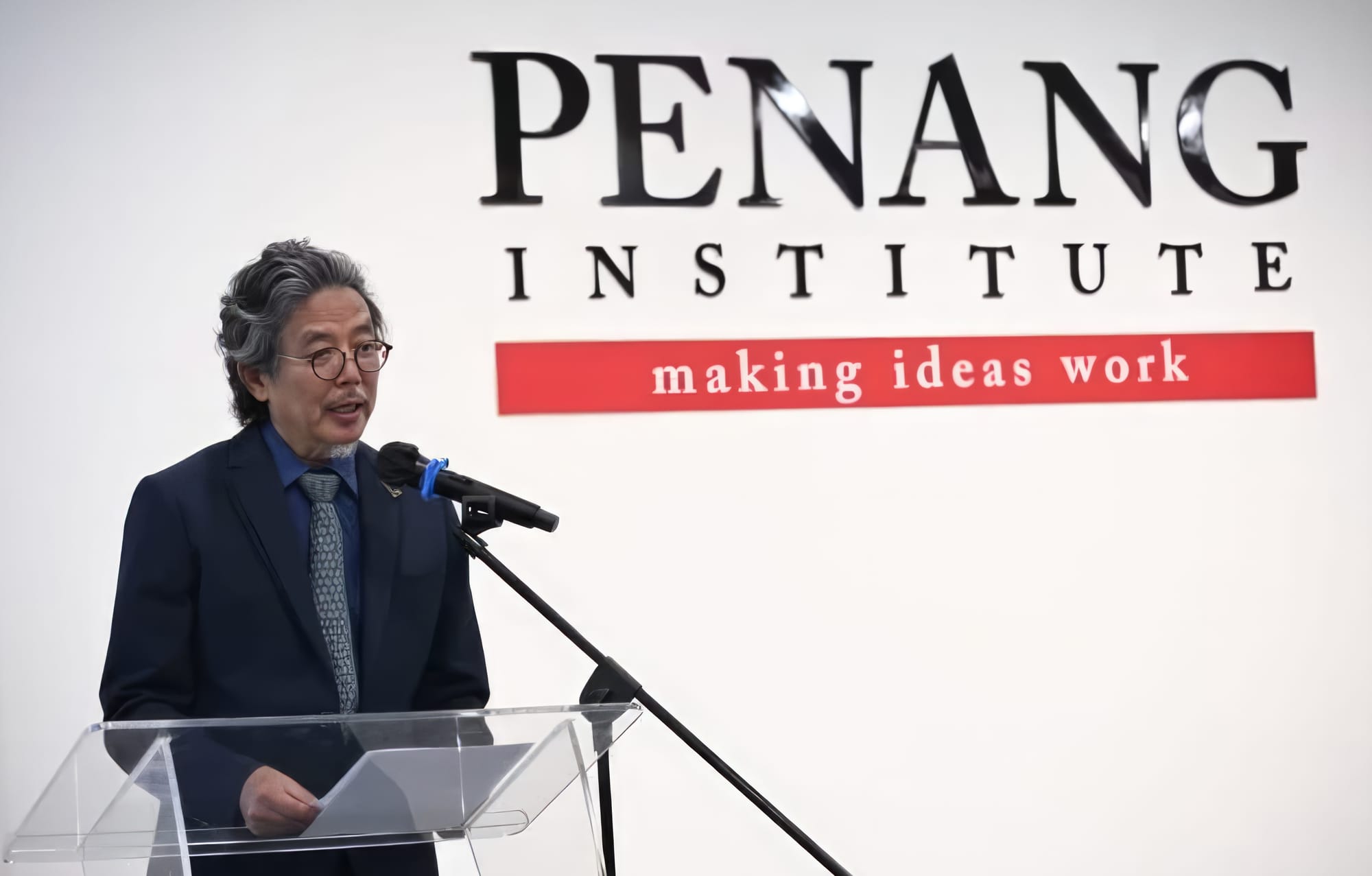
Ooi has argued that the organisation’s traditional slow-and-steady approach may no longer be adequate in an environment characterised by intense external pressure and geopolitical competition. He believes ASEAN needs to innovate, strengthen mutual trust and develop more pragmatic forms of cooperation.
“The challenge is not necessarily to turn ASEAN into a European Union-style political bloc,” he says. “That would run against Southeast Asia’s historical experience and political diversity.”
Instead, ASEAN could become more confident about acting collectively where its members share interests. Trade, supply chains, digital connectivity, climate change, health security, food security and technological development are obvious areas. So too is diplomacy.
ASEAN’s greatest strength may ultimately be its ability to bring different powers into the same conversation. This matters because Southeast Asia does not need another Cold War. The region’s interests are better served by an open environment in which China, the United States, India, Japan, Europe and other partners can all engage with ASEAN. The objective should not be to exclude the great powers. It should be to ensure that no great power dominates the region.
China and a new Asian balance
China’s rise inevitably occupies an important place in this discussion. Its economic transformation has changed Southeast Asia’s strategic environment. China is now deeply connected to the region’s trade and production networks, while its growing technological capabilities are reshaping the competitive landscape.
Bandung challenged the assumption that the international system had to be organised according to the preferences of the major powers. Today's multipolarity offers another opportunity to question that hierarchy.
But China's rise does not necessarily require ASEAN to abandon its relationships with the United States, Japan, Europe, India, or others. Indeed, the logic of multipolarity suggests precisely the opposite. The more diversified ASEAN’s relationships become, the greater its strategic autonomy.
Ooi’s thinking on China is therefore significant because he does not frame the issue as a simple impending transfer of global supremacy from the West to China. His broader argument is that China’s rise is helping accelerate a transformation in which global power is becoming more dispersed. He has described the resulting system as one in which genuine plurality is becoming increasingly visible.
For ASEAN, that could be liberating. It means Southeast Asia does not have to view itself as a passive arena for great-power competition. It can become an actor in its own right.
Ooi has previously suggested that ASEAN could aspire to become a geopolitical and geoeconomic pole comparable, in regional influence, to Japan or India. That is an ambitious proposition. But perhaps ambition is precisely what ASEAN needs.
From Bandung to multipolar future
Bandung also connects more deeply to the emerging multipolar world. Bandung challenged the assumption that the international system had to be organised according to the preferences of the major powers. Today’s multipolarity offers another opportunity to question that hierarchy.
ASEAN cannot simply preserve its old methods because they worked in the past. It must ask whether they are adequate for a world in which geopolitical competition is faster, technological change is more disruptive and economic interdependence is more complex.
The lesson is not that ASEAN should become anti-Western, pro-China or aligned with any particular bloc. It is that ASEAN should be pro-ASEAN.
Its strategic objective should be to maximise regional autonomy, preserve peace, encourage economic openness and ensure that cooperation remains possible even when major powers disagree. This is not neutrality for its own sake. It is a strategic agency.
The Bandung principles were born from the experience of countries that wanted to determine their own futures. The same instinct appears in ASEAN’s preference for dialogue, consensus, and non-interference. But Ooi’s challenge is to take those instincts further.
ASEAN cannot simply preserve its old methods because they worked in the past. It must ask whether they are adequate for a world in which geopolitical competition is faster, technological change is more disruptive and economic interdependence is more complex.
The answer may lie in a more flexible form of regionalism — one that allows ASEAN to work with different partners on different issues without being trapped inside rigid geopolitical blocs. That would be a distinctly Southeast Asian contribution to multipolarity.
New role for the Global South
There is also a wider significance. Bandung represented the emergence of the Global South as a political force. Today, the Global South has vastly greater economic weight than it did in 1955, although inequalities remain enormous.
The rise of China, India, Southeast Asia, Africa, Latin America and the Gulf states is contributing to a diffusion of economic and diplomatic influence. This creates the possibility of a more representative international order.
But multipolarity will succeed only if it avoids reproducing the very hierarchy it seeks to replace. A world with several competing hegemonies would not necessarily be better than a unipolar world.
The more desirable outcome is a system based on cooperation among different centres of power, with smaller states retaining meaningful agency. That is where Bandung’s relevance becomes particularly powerful. The conference demonstrated that countries with different political systems and national interests could nevertheless identify common principles and negotiate a shared position.
The Indonesian authorities’ historical account of Bandung emphasises how differences were managed through dialogue, deliberation, tolerance and consensus. For ASEAN, this is perhaps the most important lesson.
Dr Ooi Kee Beng’s reflections point towards a fascinating historical possibility. The world may be entering another period in which Asia is not merely responding to the international order but helping shape it.
China’s rise is an important part of this transformation. But the larger story is the emergence of multiple centres of power and the gradual decline of the assumption that one model, one region or one superpower can determine the direction of global affairs.
For ASEAN, this is a moment of choice. It can remain primarily a forum for managing differences, or it can become a more confident regional pole — one capable of shaping economic, diplomatic and strategic outcomes. The answer may lie partly in looking backwards.
Bandung in 1955 was not about choosing between Washington and Moscow. It was about refusing to accept that newly independent nations in Asia and Africa had to live by choices made by others.
In today’s multipolar world, the equivalent choice is not between America and China. It is whether Southeast Asia will allow others to define its future — or whether ASEAN will find the confidence to define it for itself. The Bandung Spirit, therefore, is not simply a memory. It is an idea whose time may have come again.
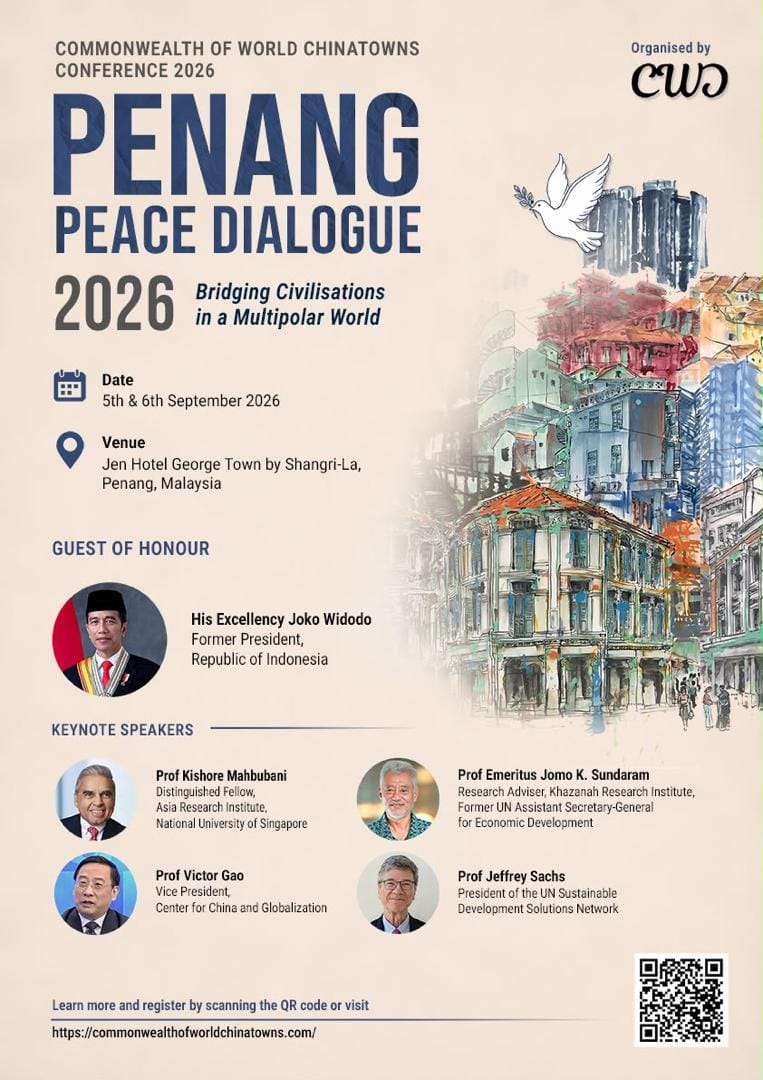
For more information on the Penang Peace Dialogue, click here to visit the official website. Click here to check out the Postscript NAC story, Penang Peace Dialogue: Bridging civilisations in a multipolar world
