Dato’ Dr Ooi Kee Beng on the changing global order, the limits of Western dominance and why China’s rise is part of a much bigger transformation
- The end of the unipolar moment and the emergence of a multipolar world
- Globalisation is changing rather than disappearing
- China’s rise is reshaping the global balance — but not necessarily replacing one hegemon with another
By Lin Siu-loong
FOR much of the past three decades, the world appeared to be moving in one direction. The end of the Cold War seemed to confirm the triumph of a Western-led international order. Globalisation accelerated, borders became less economically significant, supply chains stretched across continents and liberal economic ideas acquired an almost universal vocabulary.
But that era is now under considerable strain.
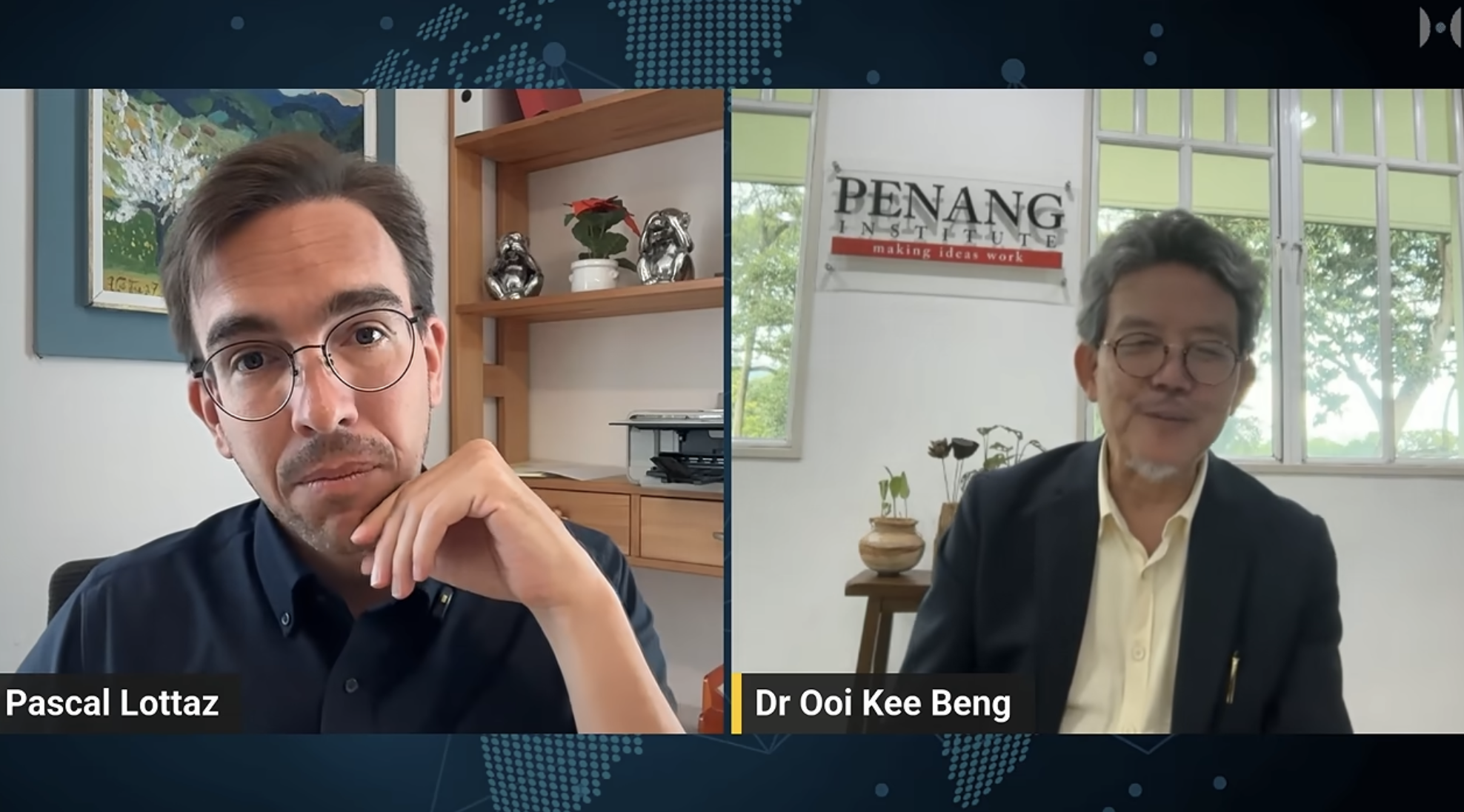
In his recent podcast interview with Dr Pascal Lottaz, of Neutrality Studies, Kyoto University, Malaysian political analyst and historian Dato’ Dr Ooi Kee Beng offers a broader interpretation of what is happening. Rather than viewing today’s turbulence simply as a contest between the United States and China, he sees a deeper transformation underway — the movement from a largely unipolar world to a genuinely multipolar one. It is an important distinction.
The temptation is to interpret China’s rise as a straightforward challenge to American supremacy: Washington was dominant, Beijing is rising, and therefore the world is supposedly moving from one hegemon to another.
China’s role in a multipolar world
Ooi’s argument is more nuanced. China’s emergence as a major economic and technological power is certainly altering the global balance. But its significance lies partly in what China’s rise reveals about the changing distribution of economic productivity, technological capability and political influence across the world.
In other words, this is not simply about China.
It is about the gradual emergence of a world in which power is becoming more dispersed. Ooi has written that multipolarity is already upon us and that ASEAN has a potentially important role in this new environment. He argues that the organisation’s development has always been shaped by wider geopolitical circumstances — from post-colonial struggles and the Cold War to the era of US-led globalisation.
Globalisation’s great transformation
Globalisation, in Ooi’s analysis, should not be understood as something that has simply ended. What is changing is its character. For decades, globalisation was strongly associated with Western economic power. Capital, technology, finance, information and major global institutions were concentrated disproportionately in the West. But East Asia’s extraordinary growth has gradually altered that equation.
China is central to this transformation. Its emergence as a manufacturing powerhouse, a major trading nation and an increasingly important technological player has helped shift the centre of global economic gravity towards Asia.
Ooi, who also runs the Penang Institute, has described this transformation as a broad shift of global economic productivity towards East Asia. The resulting supply chains have created an increasingly interconnected regional economy, while China’s technological progress has challenged Western dominance in areas ranging from electric vehicles to rare earths.
“A multipolar world does not automatically mean a more peaceful world. More centres of power can produce competition, misunderstanding and conflict." – Dr Ooi Kee Beng
“This is why the current moment should not be reduced to a simple ‘China versus America’ narrative,” he says. The deeper question is whether the world is moving away from a system in which one centre of power sets the broad parameters of globalisation. The answer, increasingly, appears to be yes. And this creates possibilities as well as uncertainties.
“A multipolar world does not automatically mean a more peaceful world,” Ooi adds. “More centres of power can produce competition, misunderstanding and conflict. But multipolarity can also create greater room for smaller countries and middle powers to exercise strategic choices.” That is particularly important for Southeast Asia.
China’s rise and the Asian Century
China’s rise is therefore significant not merely because China is becoming powerful. It matters because China is part of a wider Asian resurgence. “For Southeast Asia, this is impossible to ignore,” Ooi points out. “China is geographically close, deeply embedded in regional trade and increasingly important to investment, infrastructure, technology and supply chains.”
Yet Ooi cautions against seeing this as a simple transfer of global supremacy from Washington to Beijing. The more interesting possibility is that the world is becoming genuinely plural.
In the interview, Ooi argued that the weakening of Western dominance should not automatically be interpreted as China taking its place as the new hegemon. Rather, the result may be a more genuinely multipolar system.
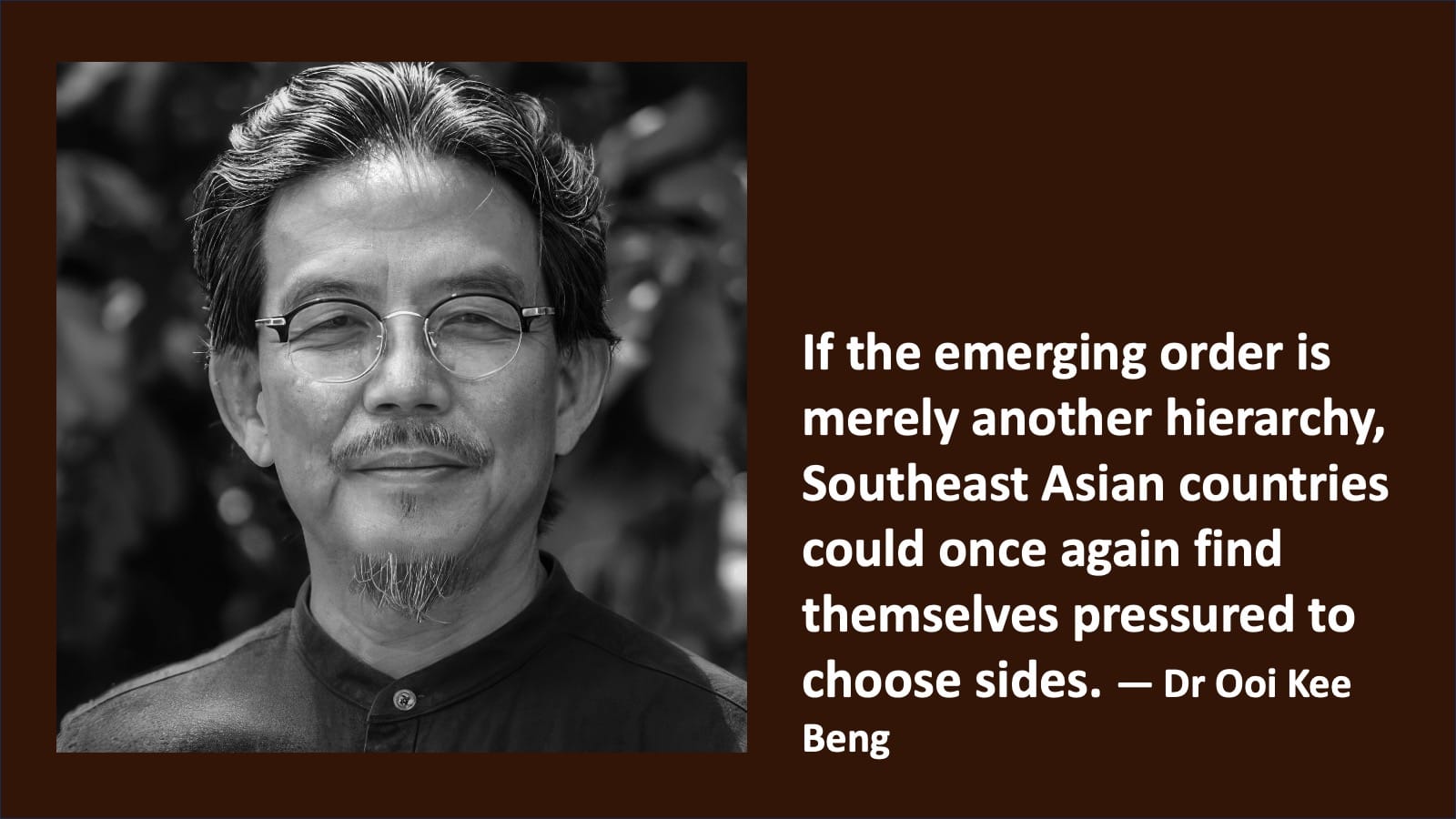
This distinction is crucial for ASEAN. “If the emerging order is merely another hierarchy, Southeast Asian countries could once again find themselves pressured to choose sides,” he says.
But if multipolarity means a diffusion of influence among major powers and regional groupings, ASEAN has considerably more space to manoeuvre. That, however, requires a stronger ASEAN.
Ooi’s criticism is not that ASEAN has failed. On the contrary, its remarkable longevity is an achievement in itself. But the habits that allowed ASEAN to survive — consensus, consultation, gradualism and caution — may not be sufficient for an increasingly turbulent geopolitical environment.
“ASEAN now faces a world in which major powers are competing openly for influence in its neighbourhood,” Ooi remarks. “The question is whether it can evolve from being primarily a mechanism for managing differences into a more confident regional actor.”
End of a simple world
The great significance of the present moment, therefore, lies beyond the immediate headlines about trade wars, strategic rivalry or geopolitical confrontation. It is the gradual disappearance of a simple world. For much of the post-Cold War era, the dominant assumption was that globalisation would progressively integrate the world around a Western-led economic and political model. That assumption is now being challenged.
China’s rise, India’s growing weight, the emergence of other regional powers and the increasing confidence of the Global South are all contributing to a more complicated international landscape. Ooi’s perspective invites us to see this not simply as a crisis but as a historical transition. The world is not necessarily becoming less global. It may be becoming more plural within globalisation. That distinction could prove decisive.
The Bandung equation
If the future is multipolar rather than merely bipolar, countries do not necessarily have to choose between rival camps. They can pursue multiple relationships, diversify their economic partnerships and strengthen regional institutions. For ASEAN, this could be an opportunity of historic proportions. But opportunity requires ambition.
The challenge is whether Southeast Asia can move beyond simply reacting to the competition among great powers and instead help shape the rules of the emerging order. That question leads naturally back to an earlier moment in Asian history—a time when newly independent nations confronted a divided world and decided they did not have to accept the choices imposed on them. It was 1955. The place was Bandung.
“ASEAN now faces a world in which major powers are competing openly for influence in its neighbourhood. The question is whether it can evolve from being primarily a mechanism for managing differences into a more confident regional actor.”
Dr Ooi Kee Beng’s reading of the current global transformation ultimately reminds us that history does not move in straight lines. The apparent certainty of the post-Cold War world has given way to a more fluid international system in which economic and political power is being redistributed.
China’s rise is an important catalyst, but it is not the whole story. The bigger story is the emergence of a world with several centres of influence — and the possibility that globalisation itself may evolve into something more diverse and less hierarchical.
For Southeast Asia, the implications are profound. The region once confronted a bipolar Cold War. It subsequently navigated a US-dominated unipolar era. Now it faces a multipolar world. The question is whether ASEAN will merely adapt to that world — or help define it. That is where the lessons of Bandung become relevant again.
In Part 2, Dr Ooi looks at ASEAN's moment of choice, the Bandung legacy and Southeast Asia's role in a multipolar world. Click here to read.
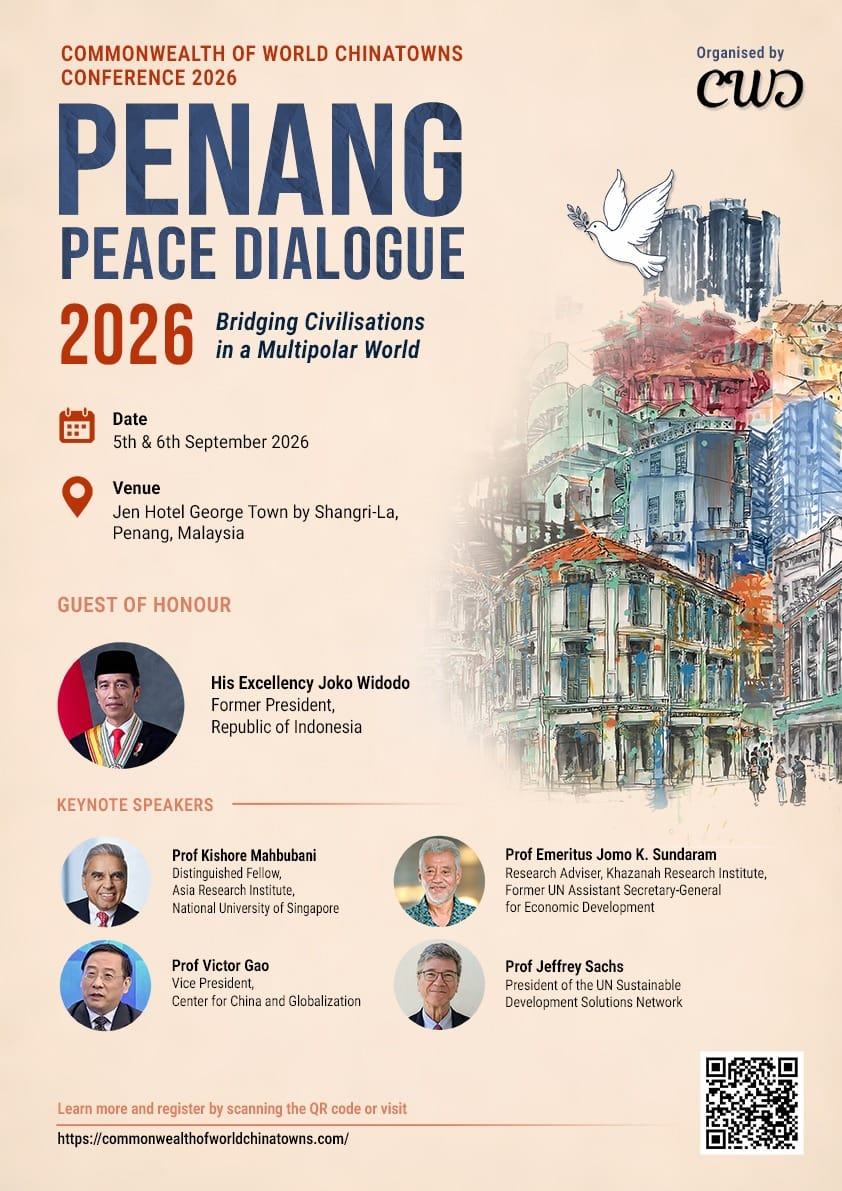
For more information on the Penang Peace Dialogue, click here to visit the official website. Click here to check out the Postscript NAC story, Penang Peace Dialogue: Bridging civilisations in a multipolar world