


- Penang’s multicultural experience offers a model for artistic exchange
- Art can challenge the old divide between domination and creation by giving different communities a voice.
- The photographers in For Our State show how memory, heritage and everyday life shape our relationship with Penang.
By Carolyn Khor
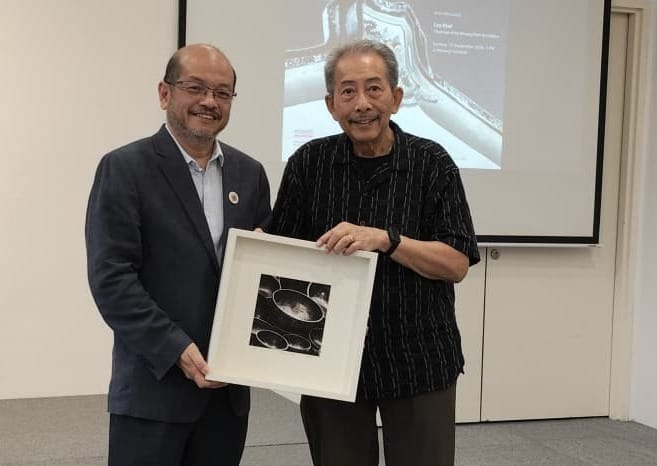
PENANG has long been a cultural meeting place, drawing artists and creative voices from beyond the island to share their work, ideas and perspectives, said guest of honour and Penang State Art Gallery chairman Lee Khai. He was speaking at the opening of For Our State: A Contemporary Photography Exhibition on Penang (Untuk Negeri Kita), where two of the seven participating artists have Penang roots while the other five come from elsewhere — reflecting, he said, the movement of people that has shaped Penang for centuries.
“Penang absorbs influences from elsewhere. People from elsewhere come and become part of our story,” Lee said. He cited Lithuanian muralist Ernest Zacharevic, whose street art has become closely associated with George Town, as one example of how an outsider can become part of Penang’s cultural landscape.
“Penang is very good at making Penangites. Penang is a meeting place,” Lee added. That idea lies at the heart of the exhibition — and also offers a way of understanding Penang’s wider experience as a multicultural city in an increasingly multipolar world.
For centuries, traders, migrants, artists and communities from China, India, the Malay Archipelago, the Middle East and Europe have arrived in Penang. They did not simply coexist. They contributed to a shared cultural landscape of temples, mosques and churches, food, architecture, language and traditions.
Penang did not become what it is by choosing one culture over another. It became Penang by absorbing influences, adapting them and allowing different communities to become part of its continuing story.
For Our State, curated by Stephen Menon under ArtVoice Gallery, provides seven contemporary photographic perspectives on that story. But the conversation surrounding the exhibition reaches beyond photography — it goes into questions of identity, memory, cultural exchange and the role of art in a multipolar world.
Penang did not become what it is by choosing one culture over another. It became Penang by learning, as Lee Khai said.
The exhibition, For Our State: A Contemporary Photography Exhibition on Penang (Untuk Negeri Kita), will run until Sept 27 at Penang Institute, 10 Jalan Brown, George Town.
Three concepts of humanity
Penang Institute executive director, Dato’ Dr Ooi Kee Beng opened the discussion with a provocation. In a presentation titled “Shifting Mankind’s Self-image”, Ooi argued that humanity is living through a critical period marked by the decline of Western dominance and unipolarity.
He described three different conceptions of humanity: Homo Sapiens, man the wise and rational, an image rooted in the European Enlightenment; Homo Economicus, man as the maximiser of self-interest, associated with Adam Smith and modern economics; and Homo Artifex, man the creator, storyteller and maker who reshapes reality and leaves an expressive mark on the world. But, Ooi asked, what about those who conquer, plunder and destroy?
For them, he coined another term: Homo Praedo — man the predator, the plunderer and the pillager. “At the risk of grave simplification,” he said, artists and art collectives need to understand themselves within the tension between these two poles — between Homo Artifex and Homo Praedo — particularly as the world becomes increasingly multipolar and the old certainties of “us versus them” begin to dissolve. “We do not want to repeat the age of Homo Praedo. One small step for us, one big step for Homo Artifex,” he said.
Penang as a civilisational model
Lee approaches the same question from a different perspective. For Lee, a co-founder of the Commonwealth of World Chinatowns that has just held the Penang Peace Dialogue, the exhibition was inseparable from that wider conversation. “Peace does not only begin in conference halls,” he said. “Sometimes it begins when we learn to look at something — a street, a building, a person, a community — and see it through another person’s eyes.”
For Lee, Penang demonstrates that civilisational exchange does not necessarily have to end in conflict. “We did not become Penang by choosing one culture and excluding another.” In an increasingly multipolar world, he believes Southeast Asia — and Penang in particular — has an important role to play. He then brought the discussion down to the level of the individual: what can an ordinary person do? His answer was implicit in the exhibition itself: look. Look carefully, and look again. “Ask yourself, what does this artwork tell me about Penang? And perhaps even more importantly, what does this artwork tell me about myself?”
Seven artists, seven perspectives
The seven artists in For Our State offer very different ways of looking at Penang, yet their works share a common thread: the idea of a place shaped by memory, movement, diversity and shared experience.
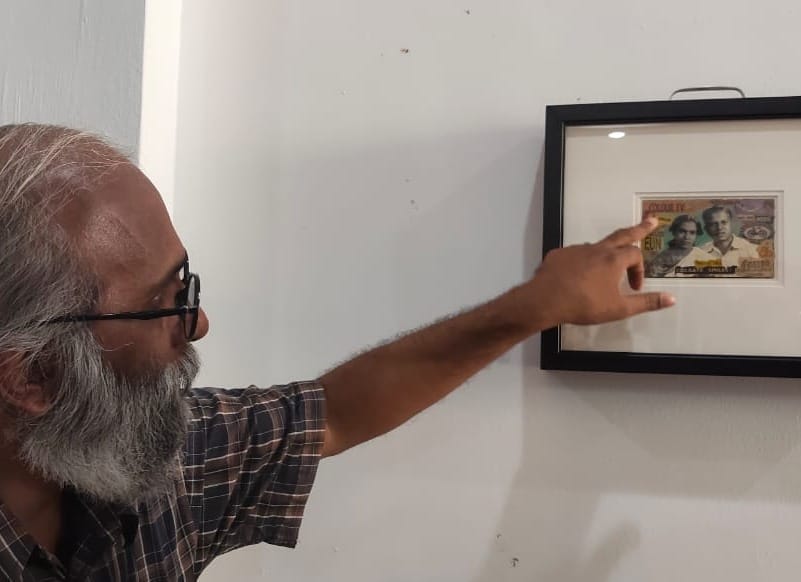
Stephen Menon, 54, the exhibition’s curator and founder of ArtVoice Gallery, established in 2018 in a restored heritage shophouse in Sentul, Kuala Lumpur, has worked to provide space for minority artists. His contribution, Life in a Postcard Series: Wish You Were Here, combines silkscreen with collaged Indian family photographs to imagine an alternative personal history of growing up in Penang.
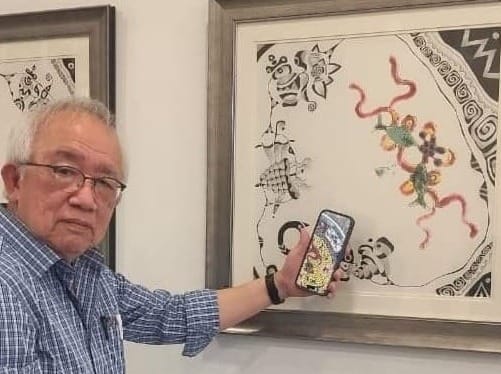
Lim Siang Jin, a veteran journalist, spent decades away from art before returning to it. His four mixed-media works are drawn on Nyonya porcelain plates. He then photographs the plates, extracts and redraws the Eight Auspicious Symbols, and pairs motifs traditionally found on Nyonya ware.
Choy Khye Fatt, 73, Penang-born, explores Straits Chinese shophouse gables and thresholds through the feng shui concepts of Heaven and Earth.
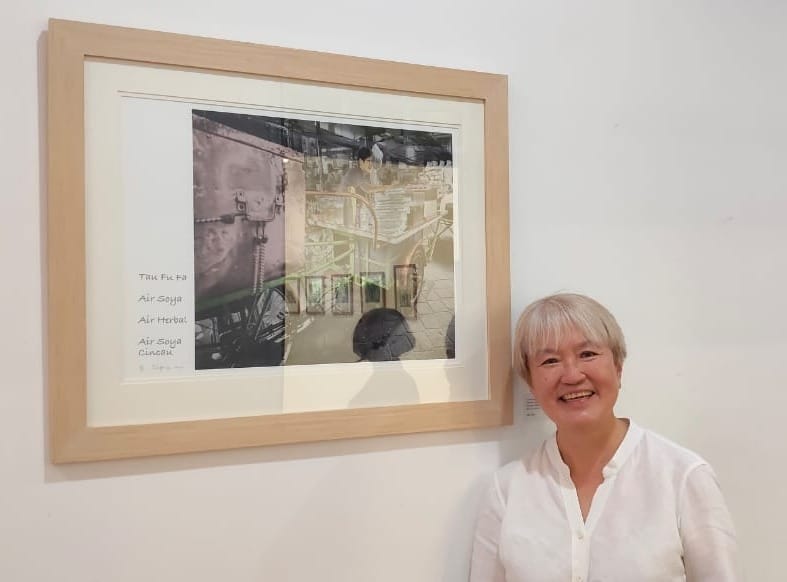
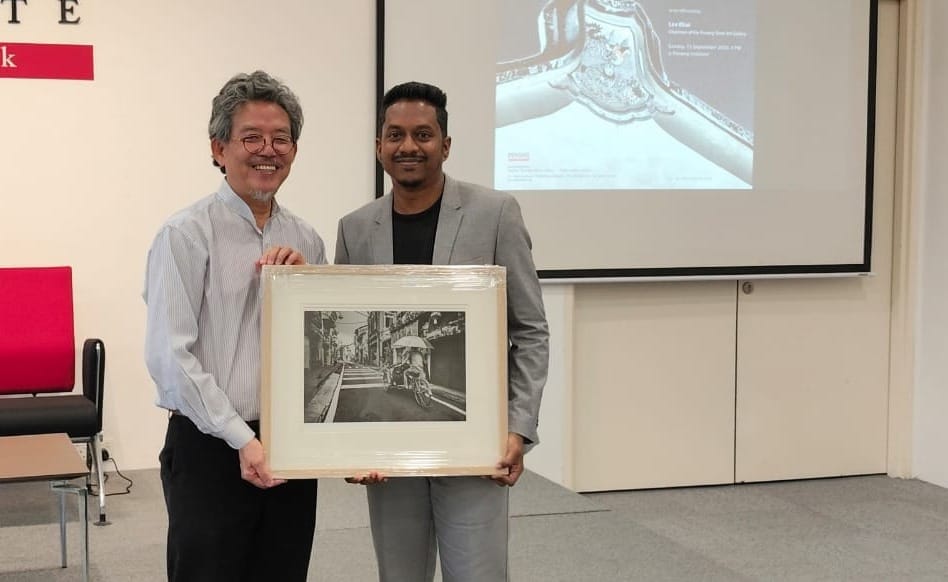
Constance Teo, 65, a Kuala Lumpur lawyer, documents George Town’s street-food vendors in Enduring Motions, finding the colours of the Penang flag in a pushcart at Lebuh Kimberley. Ravindran Munusamy, 35, a lecturer at UTAR, followed a single trishaw rider from his home at 5.30am for his black-and-white work, The Last Ride — a portrait of a working day that begins long before tourists arrive.
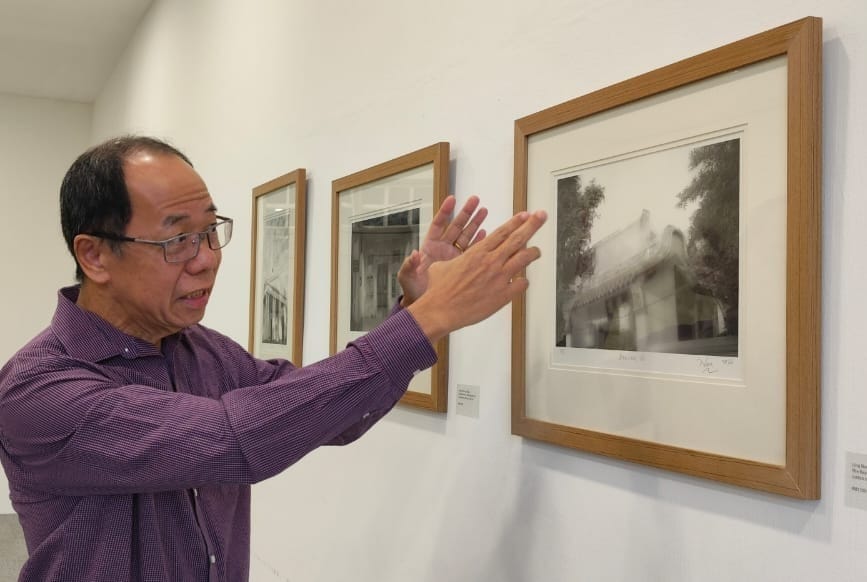
Ling Nan Ley, 66, a retired geologist from Sarawak, renders Penang’s colonial-era churches in intentional impressionistic blur, evoking age, memory and impermanence. Eric Peris’ Stalls at Daybreak I & II, atmospheric black-and-white studies of pre-dawn George Town, complete the exhibition, although the artist was unable to attend the opening.
A story in every postcard. Find out how Stephen Menon transforms vintage wedding portraits into intimate collages of love, memory, marriage and the changing face of Malaysian life here.
Seven artists. Seven perspectives. Yet together, their works suggest something larger than individual interpretations of Penang. They show how a city can be read through its architecture, food, religious buildings, streets, workers, memories and inherited traditions — and how art can make us see familiar surroundings differently.
Beyond the state
For Our State is ultimately not only about the state, as Lee put it. “It is about our relationship with the state, what we remember, what we value, what we choose to preserve, and what we choose to pass on.” That may also be where the exhibition connects most directly with the idea of a multipolar world. A multipolar world is not simply about the existence of several centres of power. It is also about how different cultures, histories and perspectives learn to occupy the same space without requiring one to erase the other.
Penang offers a living example
“Penang belongs to all of us,” Lee said, “not because we all share the same culture, but because we have learnt, over generations, to share a space.” That, perhaps, is Penang’s greatest contribution to the world — and one that art is uniquely capable of revealing.
For Our State: A Contemporary Photography Exhibition on Penang runs daily until Sept 27 at Penang Institute, 10 Jalan Brown, George Town.
