For Jomo Kwame Sundaram, the challenge to peace extends far beyond Southeast Asia. Rising military spending, entrenched power within global institutions and shifting security priorities are making the pursuit of a more peaceful international order increasingly difficult.
- The militarisation of the world today
- Reforming the global institutions a priority
- The difficult road to change for ASEAN
By Sebastian Lim
THE problems facing ASEAN are part of a much larger transformation in international affairs. Military spending is rising, particularly among wealthy countries, while governments increasingly justify higher defence budgets through growing perceptions of strategic threats.
In Part 2 of the interview, Jomo looks at how the Russian invasion of Ukraine has become a principal argument for increased military expenditure, while Japan’s leadership has increasingly identified China as a major security concern. For Jomo, this renewed emphasis on military power raises an old economic question: how much should societies devote to “guns” when resources are also desperately needed for development and basic human needs?
The dilemma is particularly significant for developing countries. The international system often discusses security in military terms, yet genuine security also depends on economic stability, development and social wellbeing. A world that spends increasingly on weapons while struggling with inequality and other development challenges risks addressing symptoms while neglecting deeper sources of insecurity. This is why Jomo links peace with economic justice.
“Sustainable development and lasting peace cannot easily be separated,” he says. “International frameworks affect domestic economic conditions, while inequality within countries can have wider consequences for stability.” Yet these issues are frequently treated in separate policy compartments. The result is a fragmented approach to closely interconnected problems.
Problem with global institutions
The same concern applies to the institutions established after the Second World War to manage the international system. The United Nations, the International Monetary Fund (IMF), and the World Bank were created with important purposes, but Jomo questions how effectively they can fulfil their peace-promoting roles under existing power structures.
The foundational principles of these institutions may remain sound, but Western dominance and the veto powers enjoyed by a small number of countries weaken their effectiveness. Reform has been discussed for years, but discussion is easier than implementation.
Jomo points to resistance from North Atlantic countries, Japan and Australia to reforms that could strengthen international commitments to peace. Entrenched interests make fundamental change difficult.
This raises an uncomfortable question: can institutions designed for an earlier balance of global power effectively manage today’s increasingly multipolar world? The answer depends not simply on institutional design, but on political will.
“A more representative international order would require powerful states to accept changes that could reduce some of their existing influence. That is precisely why reform is so difficult,” he laments.
The rise of military priorities
The shift towards greater military spending illustrates the problem. Calls for higher defence expenditure among NATO members and US allies reflect a wider trend towards militarisation. European countries, in particular, have responded more strongly to demands for increased military spending, while the war in Ukraine has reinforced the argument for greater defence preparedness.
“But higher military expenditure does not automatically create greater peace,” Jomo says. “Indeed, an increasingly militarised international environment can make diplomacy more difficult and intensify perceptions of threat.”
Peace cannot be built solely through military strength. Nor can it be sustained when economic justice, development and international representation are treated as separate questions. – Jomo Kwame Sundaram
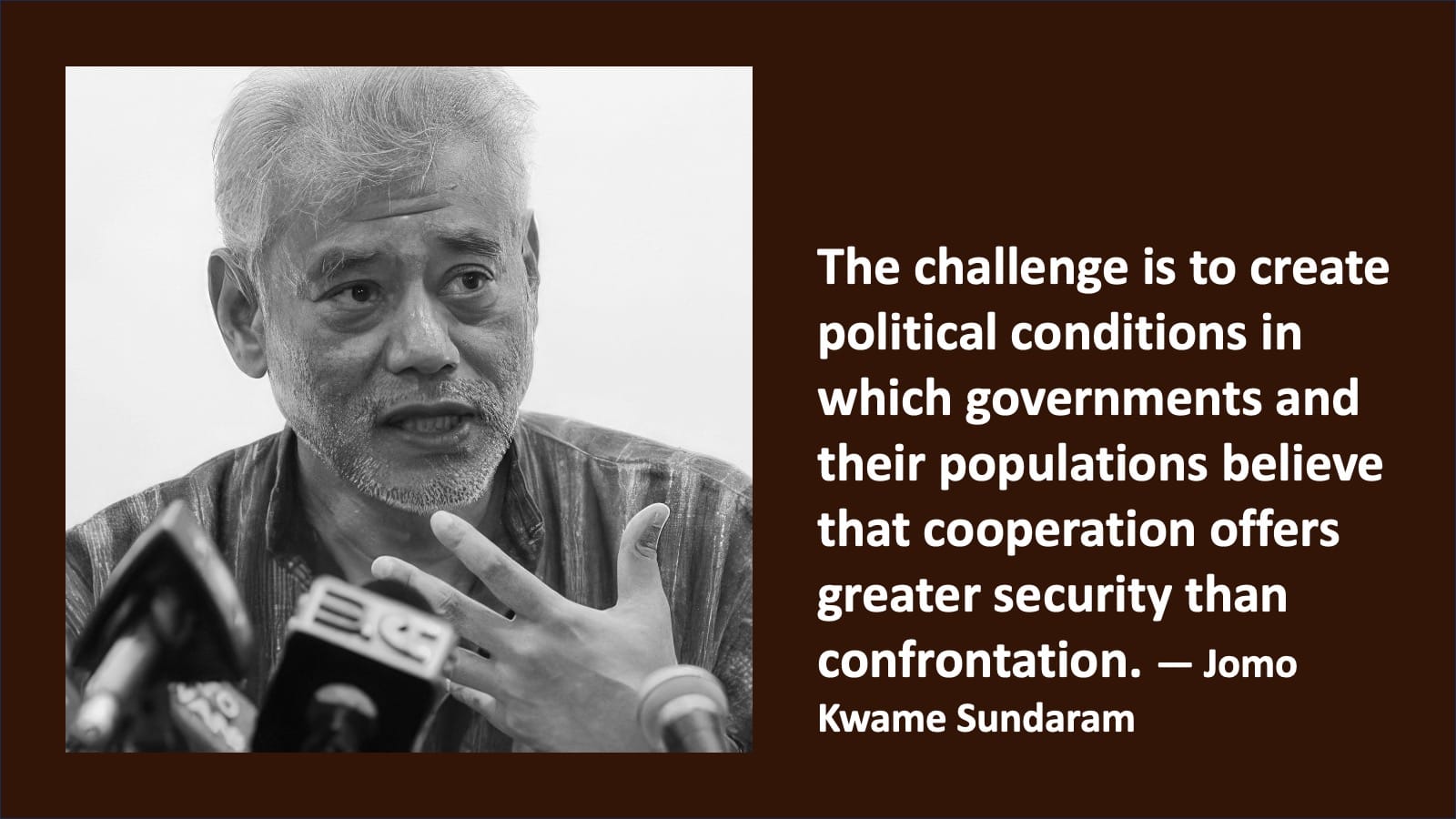
The challenge, therefore, is not simply to reduce military budgets. It is to create political conditions in which governments and their populations believe that cooperation offers greater security than confrontation.
That requires institutions capable of mediating disputes fairly, regional organisations capable of maintaining strategic independence, and political leaders willing to consider long-term interests rather than immediate strategic calculations.
Politics of reform
Jomo’s analysis ultimately points towards a fundamental problem: the world has institutions for peace, but political power does not always work in favour of peace. ASEAN’s difficulties demonstrate the problem at the regional level. The UN, IMF and World Bank illustrate it globally. In both cases, institutions are constrained by the interests of their more powerful members.
Yet the need for reform is becoming harder to ignore. The world is no longer defined by the simple geopolitical structures of the past. Economic power has shifted, new regional actors have emerged, and countries of the Global South increasingly expect a greater voice in international decision-making. The challenge is whether these changes can be translated into institutional reform.
For Jomo, the obstacles are considerable. Powerful countries remain resistant, while strategic priorities continue to favour military responses to insecurity. But recognising the problem matters.
“Peace cannot be built solely through military strength. Nor can it be sustained when economic justice, development and international representation are treated as separate questions,” says Jomo. “The future of the global peace architecture therefore depends on a willingness to connect these issues.”
Space for dialogue
This is also why forums for dialogue matter. The Penang Peace Dialogue comes at a time when ASEAN is confronting difficult strategic choices and the wider international system is struggling with questions of power, representation and reform. Its significance lies not in pretending that these problems have easy solutions, but in creating space for different perspectives to be heard.
To read Part 1 – ASEAN at a crossroads: Can Southeast Asia remain a force for peace?, click here
Jomo’s analysis offers no simplistic formula. Instead, it highlights the contradictions confronting the international community: a commitment to peace alongside rising military spending; institutions designed for cooperation operating within unequal power structures; and regional organisations seeking neutrality while facing intense external pressure. The task is to bridge those contradictions.
For Southeast Asia, that means preserving the space for ASEAN to pursue peace and strategic autonomy. For the wider world, it means confronting the inequalities and power imbalances that continue to shape international institutions.
The path will not be easy. But if peace is to mean more than the temporary absence of war, it must encompass economic justice, sustainable development and a more representative international order. The real challenge, as Jomo's analysis makes clear, is not whether the world knows what needs to change. It is whether there is sufficient political will to change it. And that may be the most important conversation of all.
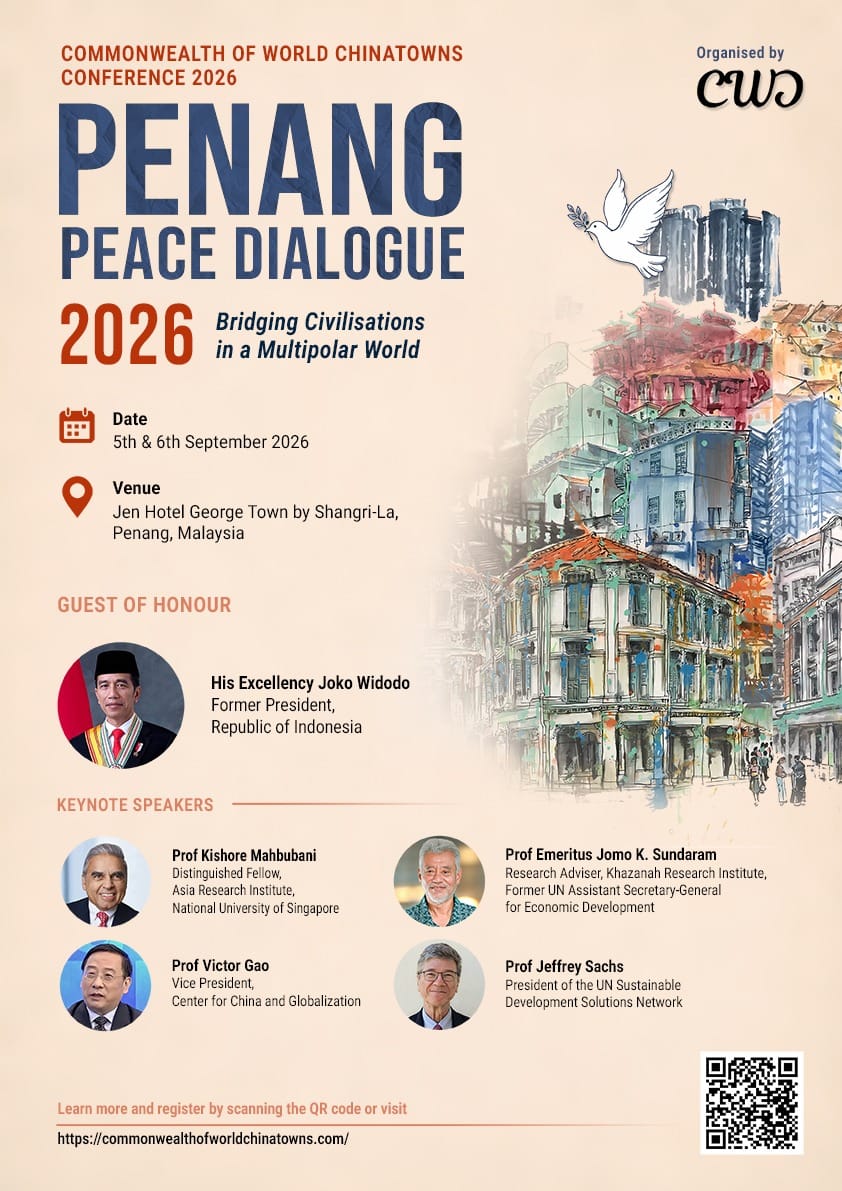
Join Professor Emeritus Jomo Kwame Sundaram at Penang Peace Dialogue 2026 at Jen Penang Georgetown by Shangri-La on Sept 5 and 6, 2026.
For more information on the Penang Peace Dialogue, click here to visit the official website. Click here to check out the Postscript NAC story, Penang Peace Dialogue: Bridging civilisations in a multipolar world